
Course Overview
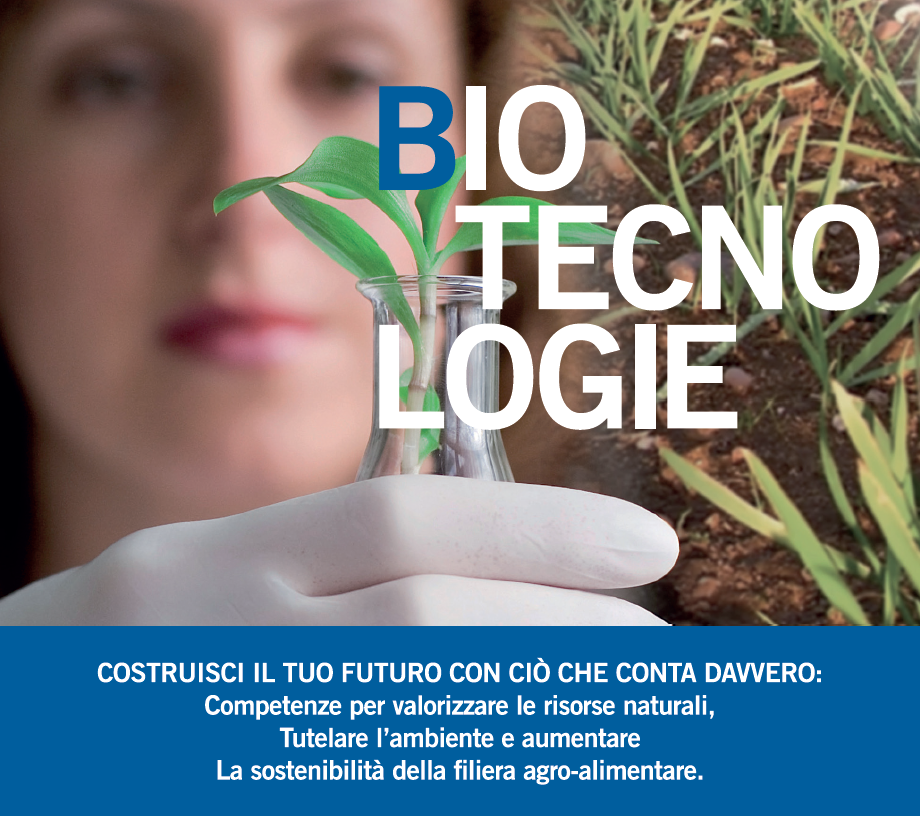

Master's Degree

ECTS 120

Location Catania

Language Italian

Class LM-7R Agricultural Biotechnology

Overall satisfaction(*) of graduates: 100%
(*) source: AlmaLaurea

Director of the Programme
Prof. M. Di Guardo
- Admission Syllabus
- Course objectives
- Admission requirements and procedures
- Career opportunities
- Teaching programme
- Final exam
COURSE OBJECTIVES
The Master’s Degree Course in Agricultural Biotechnology is the only one in class LM-7R offered in Sicily. It aims to train graduates able to:
- conduct research on biotechnology applied to biological systems in productive sectors, such as agriculture, animal husbandry, food and the environment, at public bodies, research institutes and private companies;
- work in organizations or bodies responsible for the control and certification of the genetic conformity of organisms of agricultural interest and of the health status of plant propagation material;
- carry out management and coordination activities in the R&D sectors of private organizations;
- direct research laboratories of public bodies (professional qualification is required for some roles);
- direct and manage the technical, commercial, and research and development sectors of companies operating in biotechnology or producing goods and services that use biotechnology;
- carry out professional activities to promote, design and develop innovation in fields related to agricultural biotechnology disciplines;
- develop multidisciplinary innovations by connecting the various actors of the primary sector with the world of applied research (innovation broker in agriculture);
- collaborate with public bodies at local, national or international level to develop and define guidelines and strategies on biotechnology issues (policy maker).
ADMISSION REQUIREMENTS AND PROCEDURES
The Master’s Degree Course in Agricultural Biotechnology (LM-7R) has open admission, with no limit on the number of places (open-access admission). The course is open to holders of a degree in class L-2, L-13, L-25 , L- 26 , L-32, L-38 or an equivalent degree (Interministerial Decree of 9 July 2009). Subject to a review of their curriculum, it is also open to holders of a three-year degree in other classes, or of another suitable qualification, including one obtained abroad, who have acquired at least 50 ECTS in the AGR, MAT, INF, FIS, BIO, VET, CHIM and MED sectors. Applicants who will obtain the degree or the 50 ECTS in the above scientific-disciplinary sectors by the deadlines set each year in the University’s call for admission to open-admission Master’s Degree Courses may also apply.
The adequacy of each candidate’s initial preparation will be assessed through an oral interview by a Committee appointed by Di3A. The interview will be based on a Syllabus available online on the Course website. It will also consider the candidate’s motivation, ability to synthesize, command of the topics discussed and communication skills.CAREER OPPORTUNITIES
Graduates of the Master’s Degree in Agricultural Biotechnology (LM-7R) may take the state examinations for professional qualification and registration in:
- Section A of the Professional Register of the Order of Agronomists and Foresters;
- Section A of the Professional Register of the National Order of Biologists (ONB).
The specific professional activities are governed by Presidential Decree (D.P.R.) 328/2001 and subsequent amendments. Graduates of the Master’s Degree Course in Agricultural Biotechnology may find employment in public and private companies or undertake self-employed or entrepreneurial activities.
There are many employment opportunities, including:
- Public bodies and private companies working in the genetic improvement of plants, animals and microorganisms of agricultural interest and in the development of new varieties (nursery sector), as well as in pollution remediation, environmental protection, bioenergy, and the production and valorization of high-added-value molecules of plant and microbial origin;
- National and international food safety control agencies;
- The seed industry and related activities concerning the certification and selection of plant varieties
- Companies developing microbial inoculants (biofertilizers, biostimulants, biocontrol agents, resistance inducers);
- Plant nurseries with laboratories for in vitro propagation and/or phytosanitary analysis;
- Pharmaceutical and nutraceutical industries, in both production and distribution;
- Certification bodies for primary production (foods of plant and animal origin);
- National breeders’ and breed associations, for the management of genetic improvement;
- Observatories, public bodies and private companies developing methods and tools for phytosanitary control and plant protection;
- Technical and logistical roles in the Carabinieri (Scientific Investigation Department, RIS); the Italian Navy, with specific reference to class LM-7R (registration in the Register of Biologists is required); Technical Director in the Italian State Police;
- European agencies and national bodies responsible for drafting regulations on the environmentally sustainable management of agricultural production and patent regulations on the exploitation of biotechnological products and processes;
- International cooperation agencies for technological development and environmental conservation;
- Self-employment as a Biotechnologist, Agronomist and Forester, Biologist and in related professions.
TEACHING PROGRAMME
- Molecular Biotechnology and Genomics of Crop Plants
- Entomological Biotechnology
- Biochemical Processes and Agri-Food Biotechnological Applications
- Molecular Plant Pathology
- Characterization of Vegetable and Flower Crop Biodiversity
- Sustainable Herbaceous Cropping Systems for Energy and the Environment
- Integrated Course in Biotechnology for the Genetic Improvement of Tree Species
- Genetic Improvement and Sustainable Biotechnology
- Bioinformatics Approaches for the Analysis of Traits of Agronomic Interest
- Integrated Course in Microbial and Agri-Food Biotechnology
- Bioprocesses for the Agri-Food Industry
- Microbial Genetics
- Biotech equipment and machinery
- Integrated Course in Biotechnology for Animal Production
- Authentication of Foods of Animal Origin
- Genetics and Genomics for the Improvement of Animal Production
- Economics and Policies for Agricultural Biotechnology
FINAL EXAM
The Master’s Degree in Agricultural Biotechnology (LM-7R) is awarded upon passing a final examination, which consists of preparing and discussing a written thesis based on original experimental work in one or more of the biotechnology fields covered by the degree course.
For information on admission to the final examination and the relevant assessment criteria, please refer to the Regulations of the Degree Programme applicable to the academic year in which the student enrolled.